


Collector field guide · September 26, 2026
A seller says a card is “pop 20.” That tells you something about the grading report. It does not tell you how many were printed, how many are still ungraded, or what you should pay.
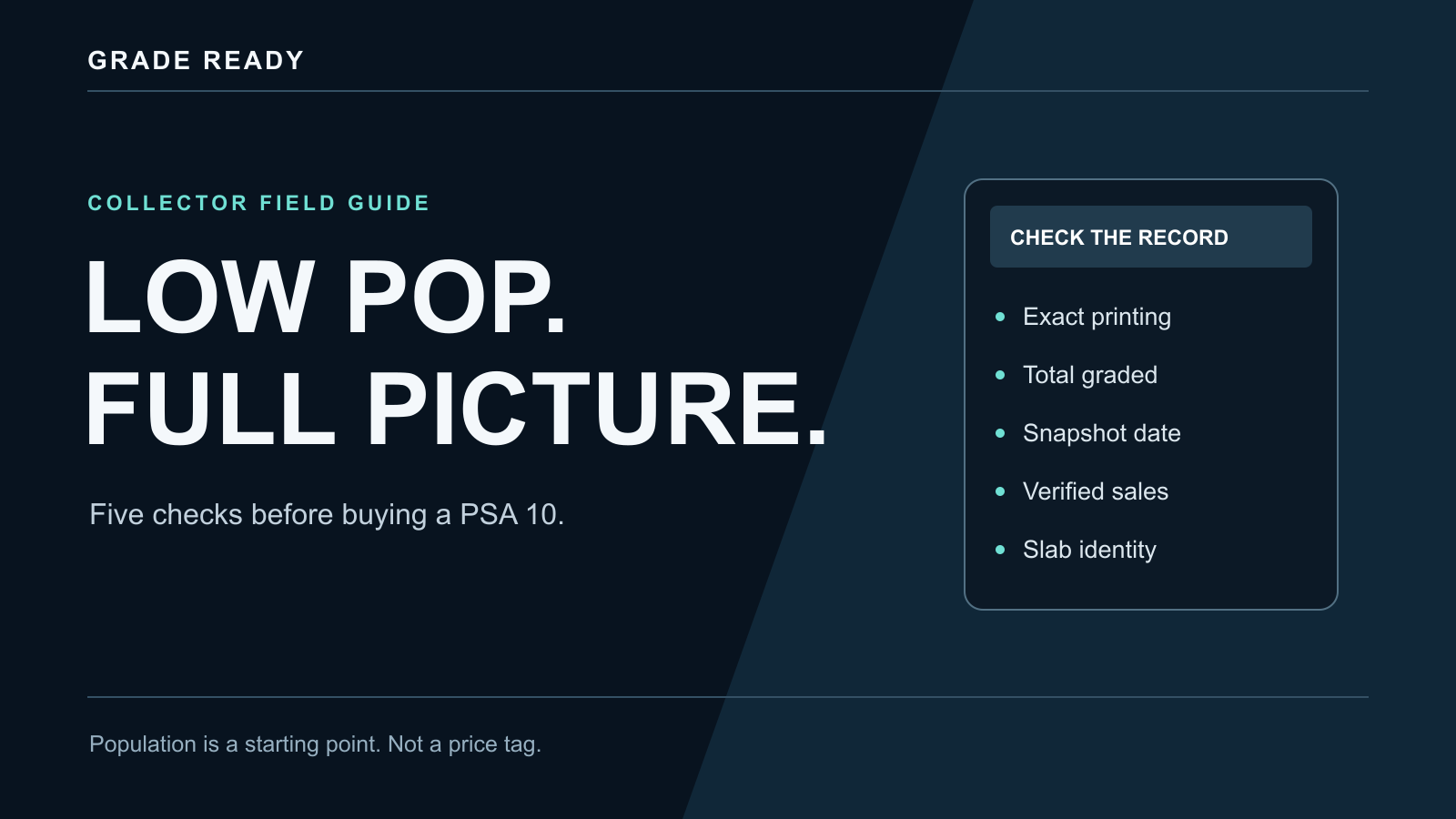
Before paying extra for a low PSA 10 population, check five things: the exact printing, the total graded, the date, comparable sales, and the slab itself.
1. Match the population row to the card in front of you
Start with the label, not the seller’s headline. Match the year, set, card number, language, and any named variety. An English card and its Japanese printing need separate checks. So do an original release and a reprint.
For Pokémon, a set symbol and collector number can separate cards with nearly identical artwork. For One Piece, the card number alone may not distinguish every alternate-art treatment. Compare the actual image and the description together.
Search the official PSA Population Report with the card number and set information. PSA notes that some varieties were recognized only after earlier copies had already been graded. A very small variety row can therefore need more context than its headline count suggests.
2. Read the total graded, not just the number of 10s
PSA defines population as the number of items graded at a particular grade. It is a grading record, not a print-run announcement. See PSA’s population definition.
Two cards can have the same PSA 10 count for very different reasons.
| Measure | Card A | Card B |
|---|---|---|
| PSA 10 population | 20 | 20 |
| Total PSA graded | 200 | 2,000 |
| PSA 10 share of that total | 10% | 1% |
The calculation is PSA 10 population ÷ total PSA graded × 100, using the same card row and snapshot for both numbers.
Card B has a much smaller share of 10s in the recorded sample. That is useful context. It does not prove Card B has a smaller print run, or that a raw copy has a 1% chance of grading a 10.
Submitted cards are not a random sample of every surviving copy. Owners decide what to send. They may pre-screen condition, choose not to grade inexpensive copies, or hold cards ungraded. Inspect the card you are considering instead of turning a report percentage into a personal grading forecast.
3. Put a date next to “low pop”
A screenshot without a date is weak evidence. Save the report URL, the date checked, the PSA 10 count, and the total graded. If you revisit the card, record a second snapshot rather than overwriting the first.
Example: a count moving from 20 to 24 means four additional PSA 10 entries, a 20% increase from the first snapshot. Those are hypothetical numbers. The arithmetic does not establish how fast future supply will grow.
On a recent release, a small graded population may simply be early. With an older card, a long release history still does not prove that every good raw copy has been submitted. Neither situation justifies assuming today’s count is permanent.
Our English Gold Star population report and One Piece Manga population report are dated snapshots. Use them to identify cards to research, then recheck the current report before making a purchase.
4. Check what actually sold
Population is not a price comp. A seller can ask any amount for a pop-20 card. To judge the asking price, find completed transactions for the same printing, language, grader, and grade.
- Open the sale: do not rely on a cropped screenshot or a headline estimate. Check the date, card description, and photos.
- Compare the full price: note currency, shipping, and any disclosed buyer’s premium. Use the same basis across your comparisons.
- Check the certification number when visible: repeated appearances of the same slab do not show several different copies entering the market.
- Keep unlike sales separate: a bundle, another language, another grade, or an undisclosed accepted offer is not a clean like-for-like comp.
One sale is one observation. If you cannot find a recent, verifiable comparable, write “limited sales evidence” in your notes. A precise-looking estimate does not fix that gap.
5. Verify the slab, not only the number
Enter the certification number into PSA Cert Verification. Compare the returned card description, grade, and any available images with the actual item. Request clear front, back, label, and holder-edge photos when buying remotely.
PSA specifically warns that a valid number does not eliminate counterfeit risk: real certification numbers can be copied. A matching lookup is a check, not a guarantee that the offered slab is genuine.
Look at the seller’s history and the transaction’s protections too. If the photos or identity do not line up, a low population is not a reason to skip the problem.
The low-pop buying checklist
Copy these fields into your card notes before you make an offer.
- Exact set, card number, language, and variety
- PSA certification number and matching report row
- PSA 10 population, total graded, and date checked
- Earlier dated snapshot, if available
- Comparable sold listings, dates, and full prices
- Clear photos and any unresolved holder or card concerns
- Your maximum spend, including transaction costs
Decision rule: treat a low population as a reason to investigate, not as proof of rarity, authenticity, or a bargain.
Three questions worth asking
Does pop 1 mean only one copy exists?
No. It describes a particular grading entry and grade in a particular report. Other grades, ungraded cards, and cards held elsewhere are outside that number.
Does a low gem rate mean my raw card will grade poorly?
No. A reported rate describes the submitted sample. It cannot replace condition evidence for your individual copy.
Can a higher-pop card cost more?
Yes. A population count does not measure how many buyers want the card or what recent comparable sales support. Check both supply context and sale evidence.
Keep the research with the card
Record the exact printing and what you paid in Grade Ready. Keep your dated population and sale notes alongside your research so you can revisit the decision later.
Sources checked September 26, 2026: PSA Population Search, Set Registry Glossary, and Cert Verification, linked above. Worked examples are hypothetical. This is collector education, not an appraisal or a promise of future value. Grade Ready is not affiliated with PSA.

2 comments
[…] Use Grade Ready to research the printing, review condition, and track what you paid. For the population side of the decision, read our five checks before paying a low-pop premium. […]
[…] a broader review of population claims, our low-pop buying checklist covers the questions a single count cannot […]
Comments are closed.