

Collector guide · October 2026
Can a Phone App Tell if a Pokémon Card Is Fake?
A card-checker app can help you spot a mismatched print or a detail that needs another look. It cannot turn a phone photo into a certificate of authenticity.
The useful part is the review process: choose the right reference, compare the visible details and keep track of what the photos do not show.

Start with identity
Match the exact Pokémon printing first
“Charizard” is not a precise enough reference. Match the set, collector number, language and finish. Check the variant too, including stamps or other printing differences.
A mismatch can make a genuine card look wrong. For example, comparing a reverse-holo copy with a non-holo reference can create differences that belong to the printing rather than the card’s authenticity.
TCG Fake Card Checker lets you select a known-real reference from supported catalogs before comparing your photo. Confirm the reference image and card details before moving on.

Use the comparison
Look at one detail at a time
A side-by-side view is more useful than switching between photos and trying to remember small details. Start with layout, then move through fine type, symbols, borders and finish.
The Checker’s wipe comparison and focus lenses help keep those areas in view. Treat an apparent difference as a question to investigate: is the reference right, is the photo sharp, and does the difference remain under another light?
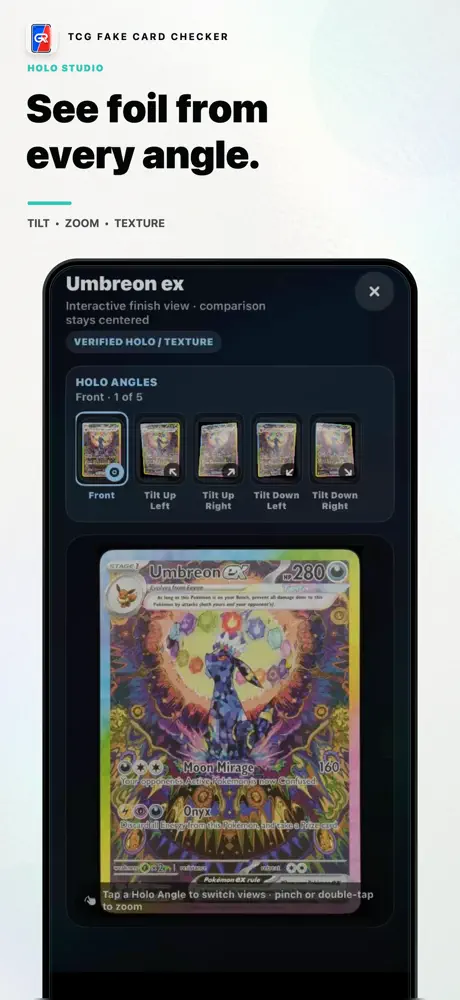
For supported Pokémon cards, Holo Studio provides reference views from multiple lighting angles. That can help you understand the expected holo or texture. It does not prove that the physical card in a listing has that finish.
Some advanced analysis and comparison tools require Premium. Check the current App Store listing for the available features.

Know the limits
A photo cannot show everything
An image may hide surface work, a small bend or a difference in the card’s construction. Reflections, phone processing and image compression can also change how color and texture appear.
A matching photo does not prove that the seller owns that copy or will send it to you. A stolen listing image can look perfect because the card in the photograph is real.
The Checker’s current App Store description is clear about its role: it supports collector decisions. It does not certify authenticity, grade cards, appraise value or guarantee an outcome.
For a valuable or disputed card, combine the photos with physical inspection and qualified expert review. If the evidence still leaves a question unanswered, “not enough information” is a reasonable place to stop.
Improve the evidence
Get four useful views
- Full front: hold the camera square to the card, with the edges and collector number visible.
- Full back: include all four corners and avoid glare across the center.
- Angled surface: change the lighting so you can follow reflections and inspect the finish.
- Close details: request a sharper view of any text, symbol, edge or mark that is still unclear.
Use the original image when possible. A screenshot of a screenshot usually gives you less detail to work with. Avoid heavy filters or edits that change the appearance of the card.
If you are reviewing a seller’s listing, our Pokémon seller-photo guide includes a more detailed photo-request workflow.
Keep the record
Save what you checked—and what is missing
Keep the reference, the seller’s actual-item photos and your notes together. Write down the specific detail that concerned you instead of saving only a broad “looks good” conclusion.
If glare blocked the bottom edge, say so. If the back was never shown, record that as missing evidence. A saved review is most useful when it explains the limits as well as the visible matches.
When looking at a graded card, also check the certification record and the holder. Our PSA cert-check guide explains why a valid number is only the beginning.
Do not damage a card with a bend, tear, scratch or water test. Ask for better evidence or arrange a qualified inspection instead.

Try the workflow with your own card
Start with a card you can photograph clearly and a matching reference. Take your time with the comparison, then keep notes on anything the images cannot resolve.
